
I’m Here To Be Real, Not To Make People Comfortable: The Art and Life of Bill Griffiths
{ Michael Collins }
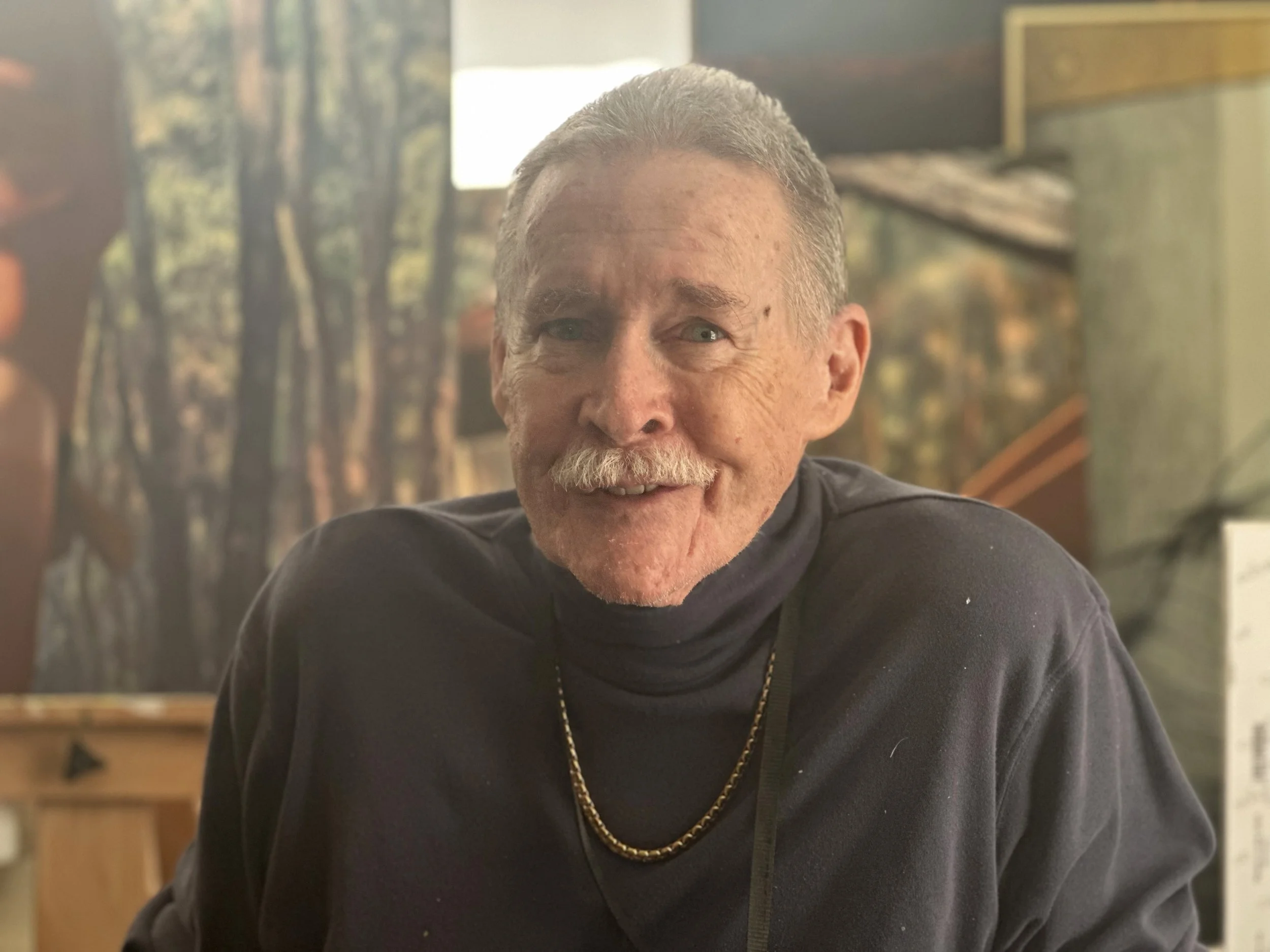
Portrait of Bill Griffiths
We agreed on $500.
I’d been trying to track down this painting for three years. Bill believed it had ended up with an old friend from Spearhead, the leather club he belonged to decades earlier, but they had long since lost touch. Then, out of nowhere, a text message arrived.
“I have it.”
It was Bill’s old friend. If I didn’t get to Brooklyn from Los Angeles within three days, the painting would disappear forever. He had fallen behind on the rent for his storage unit, and everything inside was about to be auctioned off. I made my way to Flatbush carrying an envelope of cash. We had spoken only once. Waiting beneath the harsh fluorescent lights of the lobby, I became increasingly aware of the cash in my pocket and the absurdity of the situation.
He arrived.
“Hello. Do you have the cash?”
I handed him the envelope. He slipped it into his pocket, turned and.
Had I made a terrible mistake?
A few minutes later he returned.
“Okay, let’s go.”
We rode a freight elevator upstairs. He admitted he hadn’t opened the unit in years.
“I hope I can still find it.”
The storage locker was packed floor to ceiling with boxes, furniture, old frames, and tubes. I imagined spending hours digging through decades of accumulated belongings only to discover the painting wasn’t there.
Instead, he looked around for less than a minute.
“I think it’s this one.”
He pulled down a cardboard tube nearly six feet long and slowly unrolled the canvas. It had spent almost twenty years in darkness. Against every expectation, the colors remained brilliant, the canvas pristine.
Under the Big Top is six feet tall. It depicts a strikingly fit clown in leather suspenders clutching a bouquet of balloons, while three men in jockstraps peek mischievously from beneath the oversized circus costume. It is funny. Slightly unsettling. Unmistakably queer. Entirely unlike anything most people associated with Bill Griffiths.
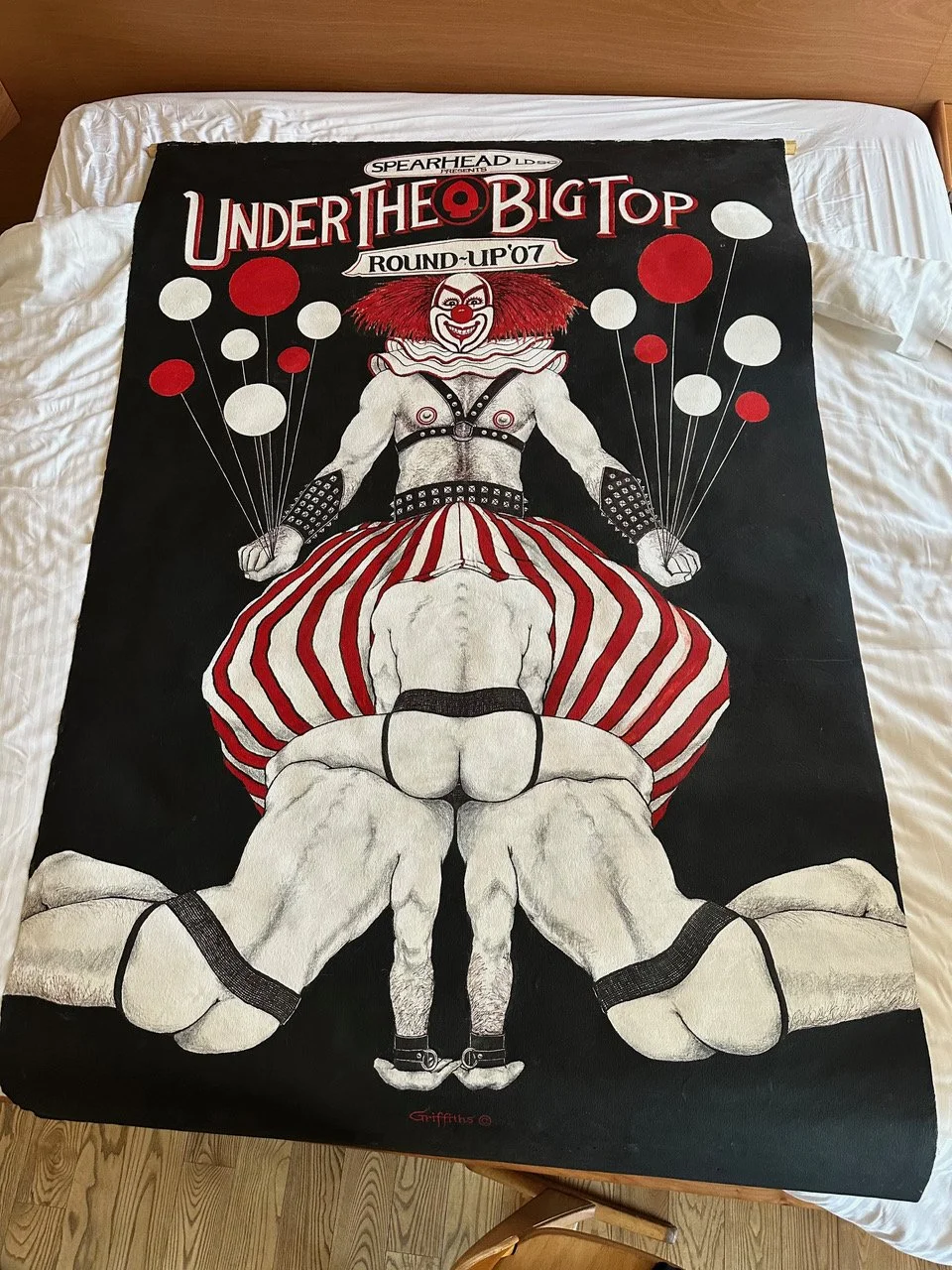
Under the Big Top
It wasn’t until I spread the canvas across the bed in my hotel room later that night that I realized I had recovered a missing piece of Bill.
Bill Griffiths probably saved my life.
As a kid growing up in central Massachusetts in the 1980s, I spent so much energy trying to suffocate the parts of myself that weren’t reflected anywhere except as the worst kind of insult. It was exhausting. When I was ten, my mother gathered my drawings and brought them to Bill, a teacher at the Worcester Art Museum, hoping he might take me on. He had never taught a child before, but he said yes. Having an openly gay mentor who was both a brilliant artist and a true original was transformative. He nurtured my love of painting, filled my world with wonder, and helped set me on a path I’m still walking today.
I know now that my story is only one of many. Bill taught at the Worcester Art Museum for nearly four decades, shaping countless lives—as a teacher, mentor, and quiet force of encouragement.
Shortly after completing Under the Big Top, Bill suffered a devastating stroke while visiting Rhode Island. The right side of his body was left largely paralyzed. For an artist whose life revolved around drawing and painting, the loss was almost unimaginable. Three years of rehabilitation followed, along with what Bill has described as a deep depression.
When he finally returned to teaching, he wasn’t yet the teacher his students remembered. For years Bill had spent each class circling the studio, stopping at every easel to offer encouragement, stories, and sharp-eyed critiques. Now, simply making it around the room was exhausting.
His students adapted without hesitation.
Several told me that whenever museum administrators stopped by to check on him, they would quietly gather at the front of the room with their paintings, chatting and asking questions so everything looked as it always had. They weren’t fooling anyone so much as sending a message: We’ve got you. After decades of Bill believing in them, they were determined to help him believe in himself again.
Little by little, they got their teacher back.
But like so many of us, even Bill carried parts of himself that he didn’t feel safe sharing publicly. While he became known for his luminous landscapes, birds, and masterful use of color and light, he was also creating an extraordinary body of work for LGBTQ+ communities across the Northeast and beyond—art that was bold, erotic, playful, and deeply alive. For years, much of that work remained in the shadows. Only after a second stroke did Bill begin sharing that fuller artistic voice without reservation.
At eighty, after suffering a second stroke, Bill found himself in a nursing home, unable to walk and told that no one in his condition ever made it out. Bill did. From his bed, with limited mobility, he began painting again. What started as a single work that took months to complete became the beginning of an entirely new chapter. The Gems series emerged, vivid, radiant figures adorned with intricate detail, followed by an explosion of new work. In the past few years, Bill has entered the most prolific period of his life.
I reconnected with him during this time, and he told me, “I’m all done making pretty pictures.”
After decades of teaching and holding parts of himself back, he decided to create freely, following his instincts wherever they led. Stroke by Stroke, his first solo show in 30 years at the Hunchback Gallery in Worcester, reflects that freedom. It brings together not just the work for which he is best known, but the full spectrum of his creative life: landscapes, intimate and erotic drawings, cryptic and playful imagery, alongside deeply personal works that, until now, few people had ever seen.
The Hunchback Gallery has made the bold choice to celebrate all of Bill, not just the familiar, but the fearless. Stroke by Stroke was both a retrospective and a revelation, and, in many ways, a kind of coming out. At a time when many artists slow down, Bill has only accelerated, creating with a vitality that feels both hard-earned and completely unrestrained.
Simultaneously, the Museum of Worcester featured a retrospective of Bill’s “safe” work, as he puts it. To see his work gathered in the city where he inspired so many of us to follow our own creative spark felt like a homecoming.
Early Work
Bill’s earliest works were created before and during his time in the Navy, and in preparation for his admission to Pratt Institute. Some were made in response to portfolio prompts, while others predate even that, offering a glimpse of a young artist already developing a distinct voice and remarkable technical skill.
Many of the themes that would define Bill’s work are already present. Powerful, self-possessed women who meet the viewer’s gaze directly reveal an early fascination with strength, beauty, and agency, inspired in part by classic film icons like Bette Davis. Vase studies, with figures partially obscured within their forms, foreshadow imagery that would reappear decades later in the Gems series, where women emerge encased in jewels and glass-like structures. What first appear to be student exercises become, in hindsight, the beginnings of a visual language Bill would spend a lifetime refining.
During his Navy years, Bill also became known for his “Griff Girls,” pin-up illustrations commissioned by fellow servicemen. For a young, queer artist navigating military culture, they became both a showcase for his remarkable draftsmanship and a way of quietly carving out space for himself within a world that demanded conformity.
Kolossus
Bill considered his rendering of the Kolossus of Rhodes to be his finest work. Commissioned by a collector determined to see the ancient wonder convincingly realized, Bill immersed himself in years of historical research, long before digital archives made such work easy. Drawing on archaeological sources and engineering studies, including the construction of the Statue of Liberty, he combined meticulous scholarship with artistic imagination to recreate one of history’s greatest lost monuments.
The collector was so taken with the finished painting that he immediately commissioned another ancient wonder, the Hanging Gardens of Babylon. Together, the two works reflect Bill’s extraordinary curiosity and technical ambition.
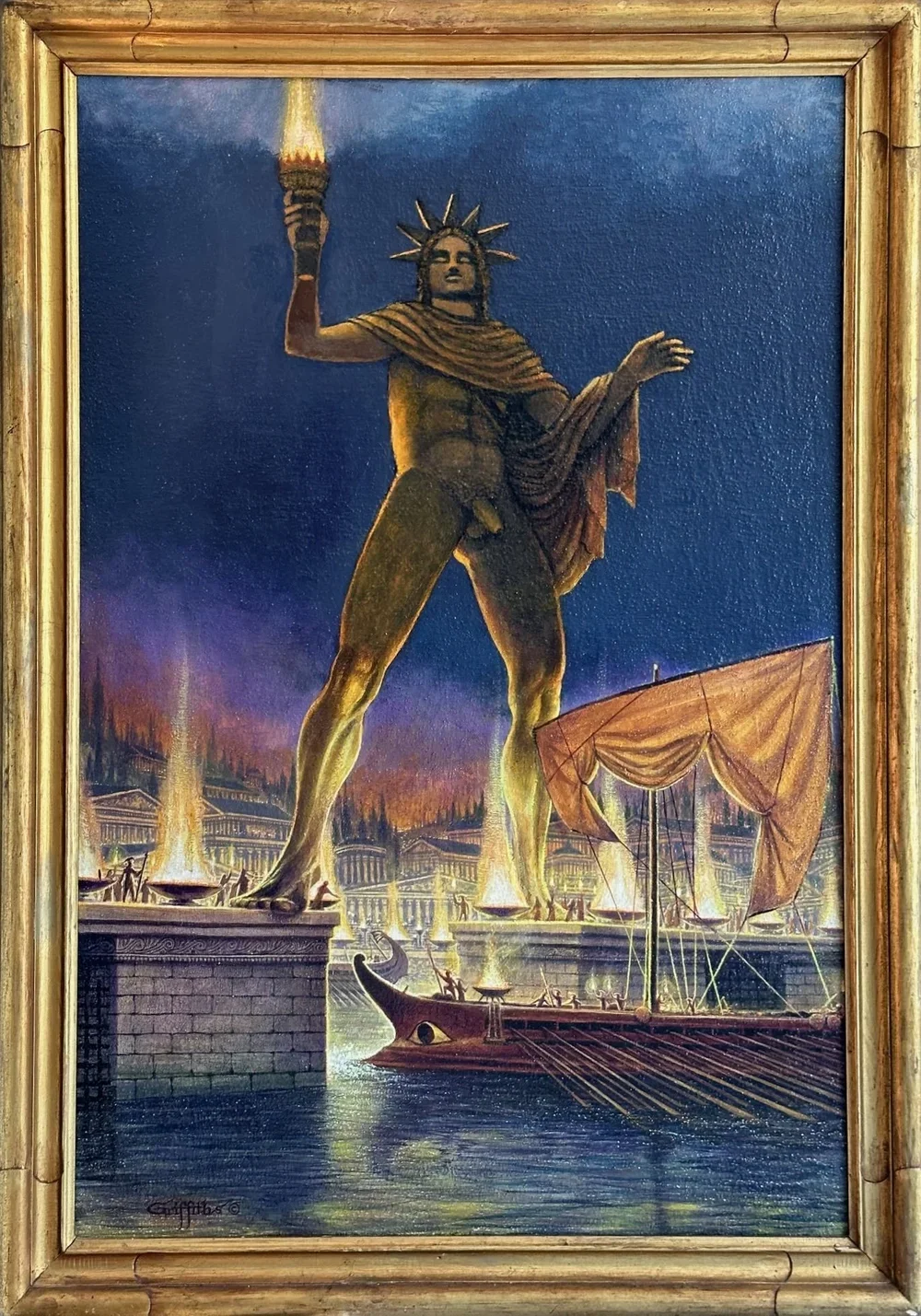
Kolossus of Rhodes
Lewdy Nudies
Before the internet transformed how queer communities connected, clubs like Boston Ducks and Spearhead were lifelines, places of belonging, experimentation, and self-expression. Their identities were shaped not only by the people who gathered there, but by the flyers, posters, magazine covers, and mailers that circulated hand to hand.
For decades, Bill helped give those communities their visual identity. He created illustrations, posters, layouts, and magazine covers for leather and fetish organizations across New England and Toronto, producing everything by hand at a time when graphic design was still a physical craft. His work wasn’t simply promotional. It became part of the culture itself, helping define the look and spirit of communities where Bill found both friendship and belonging. Today these pieces stand as vivid records of a queer world built through creativity, connection, and care.
Gems
The first painting Bill completed after his second stroke took three months. His hand moved slowly, relearning what it had once known. That work, An Emerald City Welcome, became the beginning of the Gems series: radiant, jewel-like figures bursting with color and life.
As Bill recovered, the nurses who cared for him became some of his greatest champions, encouraging him until he was finally able to return to a modest apartment in Worcester. The Gems mark more than a return to painting. They represent a rebirth, transforming illness into the most prolific period of Bill’s artistic life.
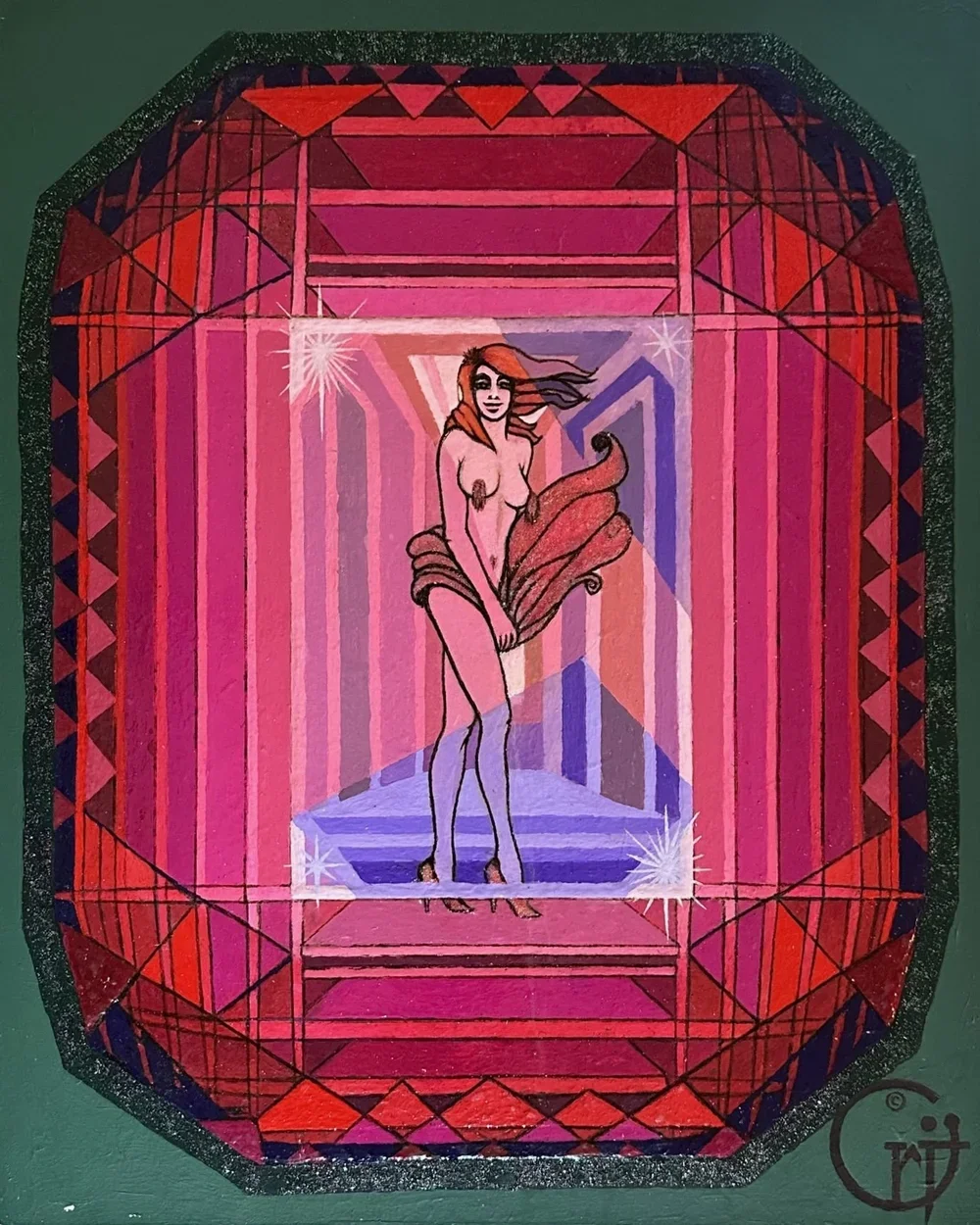
The Goddess Of Love Seen Inside A Rose Colored Topaz
Salvi
Bill began painting Salvator, his friend and muse, in the 1980s. Salvi held Bill’s work in deep reverence and trusted him in a singular way. He was the only person for whom he ever posed nude. Guided by a belief that the body was sacred, Salvi felt seen by Bill in a way that honored both his spirit and his physical form.
The series began with Lady Bug and Environmentally Suited, then expanded with Incandescent, a monumental four-by-six-foot portrait of Salvador as an angel. Not long afterward, Salvi died of AIDS. Nearly forty years later, Bill has never worked with another model, continuing instead to draw from the photographs they made together and the memories they shared.
The three newest paintings, completed within the past two years, continue that conversation. Across them, Salvi is not defined by loss but by life: radiant, playful, and enduring.
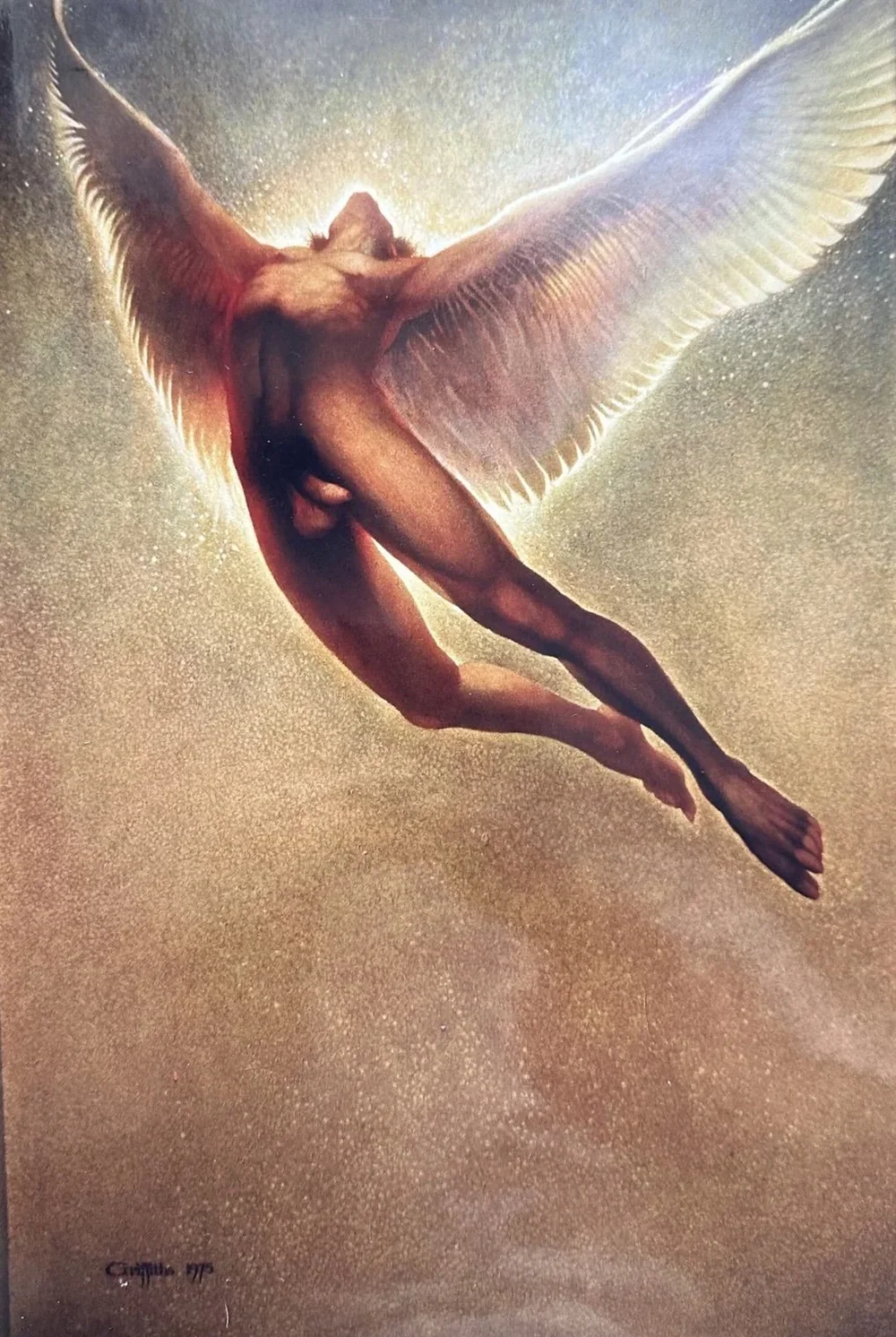
Incandescent - 4’ x 6’ Acrylic
—--------
Bill was born in 1941. His generation inherited a very different America. For much of his adult life, same-sex relationships were criminalized across much of the United States. Gay bars were routinely raided. People lost jobs simply because of who they loved. There were no legal marriages. No workplace protections. No public role models. Many people spent decades carefully dividing themselves into public and private lives because the consequences of being fully known could be devastating.
My generation inherited a world they helped build. By the time I was born, Stonewall had already happened. Coming out was still frightening, but there was at least a map. Bill’s generation had to draw the map themselves.
Bill’s generation taught many of us that silence carries a cost. Mine has learned that progress can never be taken for granted.
Which is why Stroke by Stroke felt like more than an exhibition. It was the first time many of us were seeing the whole of Bill Griffiths at once: the beloved teacher, the master painter, the queer artist, the survivor, the mentor, and the man who never stopped making art. There is something profound in that happening now, in Worcester, the city where he quietly shaped generations of artists, including me.
View more of Bill’s work at BillGriffithsArt.com
Bill’s work will be on display at the Hunchback Gallery in Worcester through the end of October.