
What Vincent’s Taught Me About Community
{ Giuliano D’Orazio }
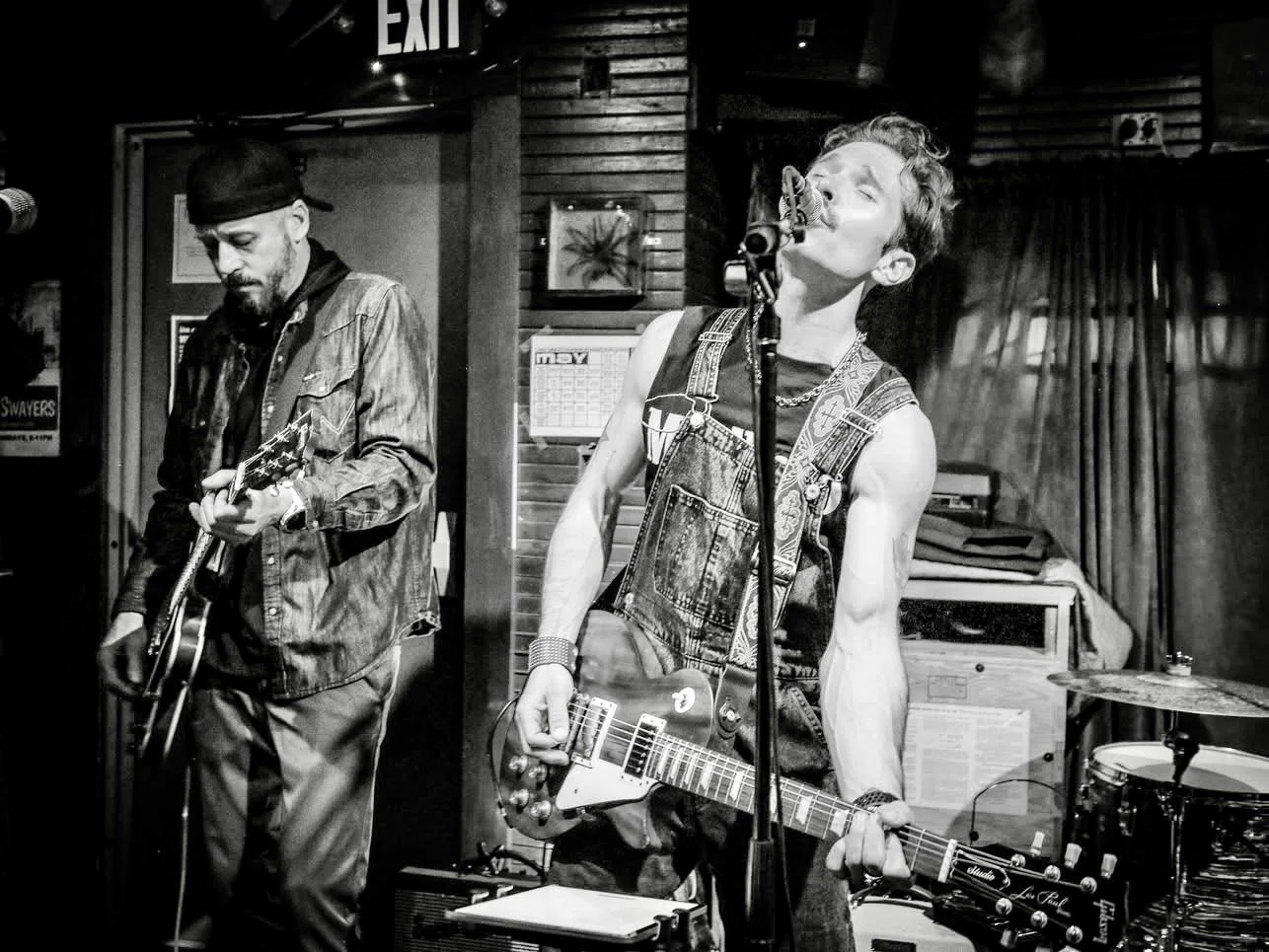
ON QUEER BELONGING, artistic responsibility, and why Worcester may be bigger than we think. Giuliano D’Orazio
On any given night at Vincent’s, you’ll find a hodgepodge of people that probably shouldn’t work and yet somehow does. I am often one of them.
There are regulars who have been sitting on the same stool for years. Musicians squeezing gear through the front door. Service industry friends enjoying a post-shift cocktail. College students. A mosaic of cultures and walks of life.
It’s one of my favorite places to perform because people can’t help but leave their assumptions at the door.
To say being an independent artist is a profession of uncertainty would be an understatement. Independent artists don’t have guaranteed paychecks, benefits, or predictable income. Every gig matters. Every relationship with a venue matters.
In my experience, being queer can add another layer of uncertainty to that equation. You don’t always know if a room will feel welcoming until you’re already standing in it—or performing in it.
Over time, though, especially in Worcester, I’ve noticed something interesting. Some of the spaces where I’ve felt most at home weren’t explicitly queer spaces at all.
One of the most common gripes I hear from queer people here is that our community feels small. Everyone knows everyone. The same names appear on the same event flyers. The same people volunteer, organize, perform, and show up. There is something beautiful about that closeness, but it can also feel limiting or even suffocating. Sometimes we talk about a lack of community when what we’re really experiencing is a lack of new connections.
I wonder how much of that comes from the fact that many of us, understandably, gravitate toward the same handful of spaces we already know are “for us.”
Those spaces matter. They’re deeply needed, and we need more of them. I celebrate and uplift the amazing queer spaces and businesses we already have in Worcester. I also believe that belonging sometimes exists in places we haven’t thought to look.
I use Vincent’s as an example because it’s a bar I’ve performed in and socialized at for years. I’ve watched queer friends walk into Vincent’s for the first time not sure what to expect, only to discover something wonderful and unexpected.
As artists, I think we have a particular responsibility here.
Part of our job is creating reasons for people to leave their houses and gather in a room together. If we care about strengthening Worcester’s queer community, we should think not only about who showed up last time, but about who we hope will show up next time. How do we create events that welcome new people? How do we create work that inspires a wider audience? How do we introduce communities to one another if we stay in separate corners?
That responsibility extends to our craft, too.
Early in my career, I assumed that if I worked hard and people liked me personally, audiences would naturally follow. Sometimes they did. More often, I learned that good intentions aren’t a substitute for great work. The artists so many of us admire aren’t simply talented—they’re relentlessly committed to improving what they do.
And this is where I might lose a few people.
Nobody owes us an audience.
Not because we’re artists. Not because we’re queer. Not because we’re friends.
When people show up to support us, it’s a gift. But if we want sustainable careers and a thriving cultural scene, support alone isn’t enough. We have to make work that earns attention. We have to ask ourselves the difficult questions.
Would I buy a ticket to this?
Would I stay for the whole show?
Would I tell someone else to come next time?
If Worcester wants to compete with Boston, Providence, or New York as a destination for queer arts and culture, the answer isn’t simply asking for more support. It’s creating work so compelling that people can’t help but pay attention.
The talent is already here. The passion is, too. Let’s open ourselves up to the exciting possibility that our community may be bigger than we think it is. There are people we haven’t met yet. Rooms we haven’t walked into yet. Collaborations we haven’t imagined yet.
If we’re lucky, the work becomes bigger than a performance—it becomes an invitation. We can keep asking why the same people show up, or we can start creating reasons for new people to walk through the door.