
{ Wil Darcangelo }
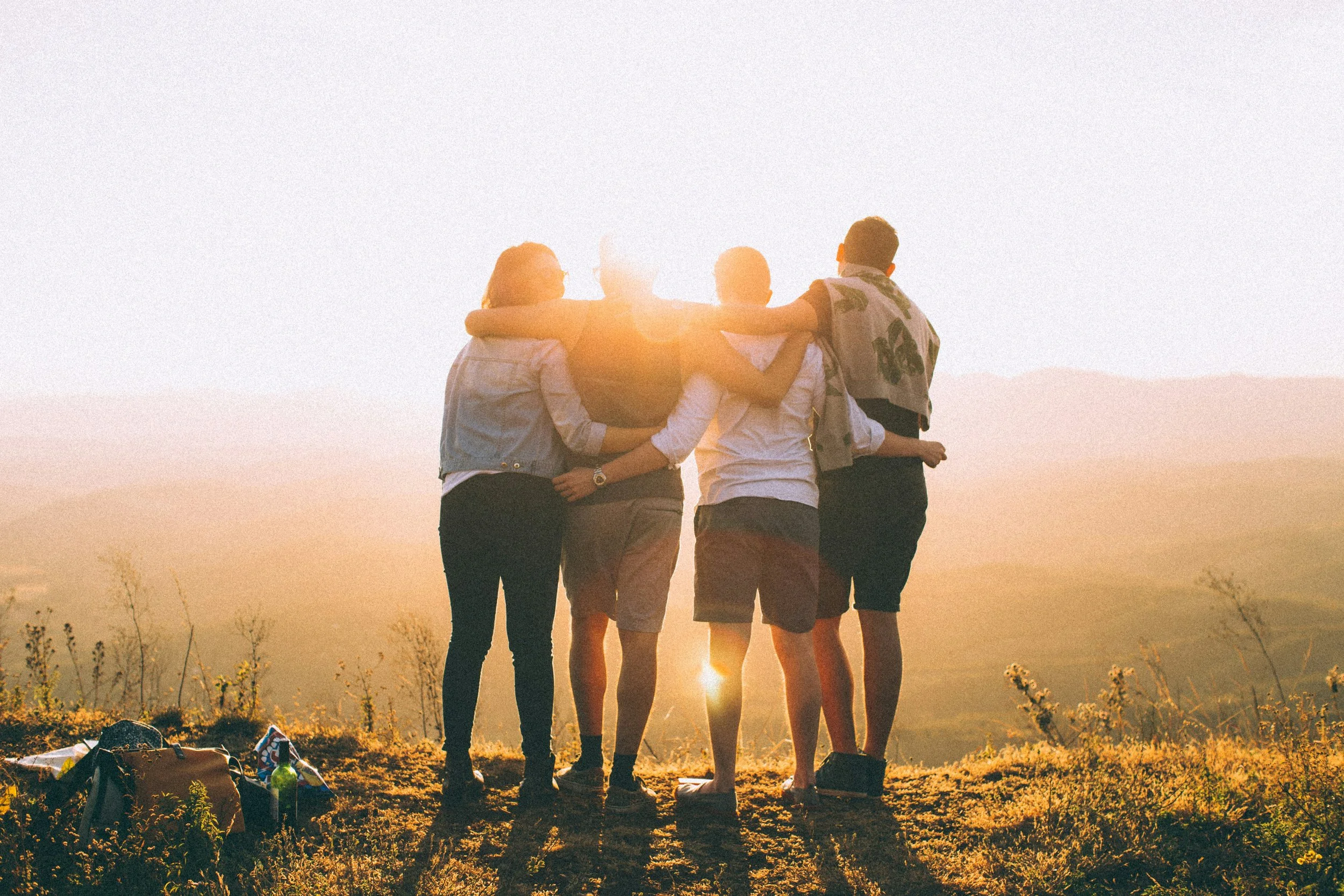
In “The Velveteen Rabbit,” love is what makes the rabbit real. Chosen families become real in much the same way — not through biology or permission, but through the repeated practice of choosing one another.
“The Velveteen Rabbit,” by Margery Williams, was one of my favorite books growing up. In high school, I even played the Little Boy in a stage version of it.
The story has remained with me because it asks a question most of us spend our lives trying to answer: What makes something real?
The Velveteen Rabbit begins as merely a toy — something manufactured, acquired and placed among other toys. But the rabbit learns that becoming real has nothing to do with how he was made. It happens through relationship. Through being held, carried, confided in, worn down and loved.
The rabbit does not become real because someone officially declares him so. Love makes him real.
Every year around the holidays, we are surrounded by similarly powerful stories about what makes a family real.
Families gather around tables. Families return to childhood homes. Families exchange gifts beneath glowing trees. Advertisements, movies, greeting cards and songs reinforce the same familiar picture: Family is where you come from. Family is the people whose blood you share. Family is where you will always belong. Family is the group to whom you are obligated to return — even if they have caused irreparable harm.
For many LGBTQ+ people, that picture isn’t merely complicated. It can be existentially demoralizing.
Some of us feel compelled to return home knowing there are parts of ourselves we must leave outside. Some prepare for questions that are not really questions, derisive jokes that are not really funny — except to those telling them — or silences weighed down by disappointment in us. Some discover that an invitation to come home is not necessarily an invitation to arrive as our authentic selves.
Some are no longer invited at all.
And now, just as LGBTQ+ people were beginning to gain real traction— just as more families, schools, workplaces, congregations and communities were learning to recognize the full humanity of gender-expansive people — the political winds have shifted sharply against us.
Transgender, nonbinary and gender-nonconforming people are once again being publicly discussed as problems to be solved rather than people to be loved. Their health care, participation in public life, presence in schools, identification documents, and even the language available to describe their existence have become political battlegrounds.
This rhetoric does not remain inside legislatures, campaign rallies or television studios. It follows people home.
When political leaders describe someone’s identity as fraudulent, dangerous or ideological, they give private prejudice a kind of public permission. A parent can begin to imagine that rejecting their child is not rejection, but virtue. A relative can mistake cruelty for moral courage. A family can persuade itself that withholding love is an act of faith.
The consequences are not abstract. They are sitting at holiday tables— or discovering that there is no longer a seat waiting for them at all.
That rejection leaves a very particular wound. And contrary to some of the more sentimental stories we tell about chosen family, the wound does not always disappear simply because other people love us well.
A wonderful chosen family does not make it painless when a parent refuses to accept you. A loving spouse or circle of loyal friends cannot erase the memory of being told that your love — or your very self — is shameful. New love cannot retroactively cancel old rejection.
The hurt may soften around the edges over time. It might become less central. We may grow strong and joyful lives around it. But sometimes it remains — a tender place that still aches when touched. Just like all real grief does.
Acknowledging that does not diminish the love of our chosen families. It reveals why they matter so much.
My own understanding of family has been formed as much by choice as by inheritance. Though I was fortunate enough to grow up in a family who has always loved and accepted me, my husband Jamie and I have built a life together through all the ordinary, unglamorous acts from which a marriage is actually made: showing up, making decisions, managing disagreements, laughing, sharing responsibilities and continuing to choose one another through change. In marriage, Jamie chose my name. Making us feel even more like the real family we are.
Our family grew when we adopted our blind and autistic daughter, Lavender, as an adult. She had estranged herself from her biological family, but her disabilities were such that she needed a new chosen family to love her and publicly name her as their kin. Lavender took our last name as well. Those facts alone challenge many assumptions about how family is supposed to happen. We tend to imagine adoption primarily as something adults do for young children. But family can recognize itself at any age. Sometimes the legal act does not create the bond so much as finally give a truthful name to a bond already there.
We’ve also gathered friends who became family — not through a single declaration or ceremony, but through the continuity of genuine presence. Jamie and I became the heirs of our late housemate, and my best friend, Peter, for whom we gave hospice in our home last summer as he passed from cancer. As I write this, today is the one-year anniversary of his passing. Tonight, his sister and a circle of his closest friends will gather to scatter his ashes. Chosen family is very much on my heart today. And no one could dare tell me it wasn’t 100% real.
Jamie’s former partner, Christoph, had two strokes in his early 40s, eight years into their 13-year partnership, leaving him profoundly disabled and in need of regular care for the rest of his life. Even after they ended their romantic partnership, even after Jamie and I met, fell in love and married, Christoph was part of our family too. He lived with us for three years until his needs became more profound than could be handled at home. But even in the nursing home, and later a residential home, Jamie was always his family. And by extension, so were Lavender, Peter and me until the day he died.
I officiated both of their funerals.
Like the Velveteen Rabbit, these relationships became real through being loved. Not through sentiment alone, but through the wear and tenderness of actual life. Through being carried into difficult rooms. Through being held when the stitching felt loose. Through time, trust and the marks left by having shared a life.
Over time, loyalty becomes deliberate kinship.
And yet our culture still tends to speak of chosen family as though it were a consolation prize: a heartwarming substitute offered to people unfortunate enough not to possess the genuine article. Even the phrase “like family” can reveal the “less-than” insinuation. Someone is “like” a brother, “like” a mother — but not quite the real thing.
Perhaps that is why the question at the center of “The Velveteen Rabbit” matters so much. What makes a family real?
Is it biology? A biologically shared name? A branch on a genealogical chart? Or is a family made real through the practice of being family?
Queer people tend to know the answer.
We’ve had to know because so many of us learned, sorrowfully, that biology does not guarantee belonging. Shared genes cannot promise tenderness. Kinship may create obligations, memories and deep attachments, but it does not automatically produce safety or acceptance.
By the same measure, the absence of shared ancestry does not make love imaginary.
Family becomes real wherever people accept responsibility for one another’s flourishing. It becomes real through presence. It becomes real when someone says, through words or actions: You do not have to become smaller to remain welcome here. In fact, we want you to become as expansive as possible.
This doesn’t mean biological family is irrelevant or replaceable. Many of us love our families of origin profoundly, even when those relationships are difficult — even toxic. We may continue longing for their acceptance after building lives filled with other forms of love. Chosen family should never be used to shame someone for still missing those who rejected them.
We can be grateful for what we have gathered and still grieve what we were denied. Both things can be true.
But the queer experience offers a larger lesson about family — one that everyone, queer or not, might need. Most families are partly chosen anyway. Marriage joins people by choice. Adoption makes a public covenant of belonging. Friends and neighbors become emergency contacts. Congregations, recovery communities, caregiving circles and even groups that meet at the same bar every Friday begin carrying one another through life. We already gather families by default. It is part of what makes us human.
What might happen if we began doing it more consciously and with discernment?
We could ask not only, “Who are my relatives?” but also, “Who has entrusted part of their life to me?” We could notice who consistently appears at the edges of our celebrations. We could recognize the person who has nowhere safe to go for Thanksgiving and deliberately invite them in.
Then we could make room. We could make the practice of hospitality our religion. Not from pity. Not as charity. And not because we are offering someone a temporary seat until their “real” family comes around. We make room because this is one of the ways real family always comes into being.
Chosen family is not defined by perfection. No family is. These relationships can disappoint us, misunderstand us, and sometimes end, just as biological families can. Choice does not make a bond disposable, nor does it make every friendship sacred. Discernment matters. Trust must be earned. Healthy families require boundaries as well as openness.
But we are allowed to name as real family those who have done the work of real family.
We are allowed to honor the people who found us, stood beside us and kept choosing us. We are allowed to build homes, traditions, holiday tables and networks of care that tell the truth about where love is actually present.
And in this political moment, chosen family is more than companionship. It is part of our communal infrastructure. It is how we keep one another safe, remind one another what is true and protect the expansive humanity that others would prefer us to surrender.
There will always be people who look at the family we have gathered and wonder whether it counts. Whether it is authentic. Whether it is real. But real is not something they get to decide.
We know what has made us real to one another. We know who has carried us, held us and loved us through the wear and tear of becoming ourselves.
This season, look around at what you have already gathered. And then gather more.
Somewhere nearby, someone may still be waiting to hear the words through which love begins its transforming work: There is room for you here.